
Throughout his career as a surgeon, Dr. Samuel Bledsoe has worked to improve access to medically necessary healthcare in Arkansas. Much of that work has focused on metabolic and bariatric surgery, a treatment historically excluded from many insurance plans even for patients with severe obesity and serious related illnesses.
His healthcare advocacy has included organizing legislative initiatives, raising funds to support those efforts, working with legislators and professional colleagues, and testifying before Arkansas legislative committees. It has contributed to two significant changes in state healthcare policy: Act 109 of 2022, addressing bariatric surgery coverage for eligible public employees, and Act 628 of 2025, expanding coverage requirements for qualifying commercial health insurance plans and addressing Arkansas Medicaid separately.
Expanding Bariatric Surgery Access for Arkansas Public Employees
The Early Pilot Program: 2011–2017
Arkansas authorized a bariatric surgery pilot program for public employees through Act 855 of 2011. Enrollment began in 2011, with the first surgeries performed in 2012. Act 927 of 2017 subsequently extended the program.
Late in 2017, the Arkansas Employee Benefits Division (EBD) met with interested parties to discuss the program’s future, including whether it should continue. The pilot had been expected to generate data to help determine its long-term value, but the planned evaluation had not been completed. Dr. Bledsoe attended with a group of other concerned stakeholders to discuss the importance of maintaining access while that question was considered. The program continued. This was a collective effort involving multiple participants.
The 2021 Segal Review and Act 109 of 2022
In 2021, the State of Arkansas commissioned Segal to conduct a comprehensive review of its employee and public school health insurance programs. Concerned that the review might lead to elimination of the bariatric surgery benefit, Dr. Bledsoe organized a separate advocacy effort to explain its clinical and financial importance.
He raised approximately $40,000 to support the effort, engaged a lobbyist, coordinated outreach to legislators, and provided testimony to the Arkansas Legislative Council Executive Subcommittee on September 22, 2021.
Segal’s final report, dated November 16, 2021, included an independent claims analysis of public-plan members who underwent bariatric surgery in 2019. The analysis compared the 12 months before and after surgery among 244 members with complete claims data.
What the Segal Report Found
In this before-and-after analysis, Segal reported the following changes in per-member-per-month healthcare expenses and utilization:
- 37% lower total healthcare expenditures ($797 before surgery versus $502 afterward).
- 45% lower medical expenditures ($572 versus $316).
- 17% lower prescription drug expenditures ($225 versus $187).
- 38% fewer emergency department visits during the following year.
Among 137 members with recorded BMI categories, 80% had improvement in their documented BMI category. These were observational comparisons of claims over two different 12-month periods, not randomized findings or guarantees of future savings. Segal recommended removing the program’s annual financial cap, using standard carrier medical-necessity criteria, and making the separate nurse-coaching requirement voluntary.
These findings informed the subsequent policy discussion. Arkansas Act 109 of 2022, approved March 1, 2022, established a broader statutory framework for bariatric coverage under the State and Public School Life and Health Insurance Program, with expanded benefits implemented beginning January 1, 2023. Dr. Bledsoe initiated and coordinated much of the independent advocacy effort that brought the issue before lawmakers; the legislation itself was enacted through the work of the General Assembly and numerous participants.
Primary sources: Read Act 109 of 2022 (PDF) • SB87 legislative history • Watch September 22, 2021 testimony • Read the Segal Report (see printed pages 43–44).
Related perspective: Dr. Bledsoe’s January 2023 column on Act 109 and bariatric surgery access.
Act 628 of 2025: Expanding Access Beyond Public Employees
Although Act 109 expanded the public-employee benefit, many other Arkansans continued to encounter explicit bariatric surgery exclusions in commercial insurance policies. These exclusions could prevent patients from receiving treatment even when they met accepted clinical criteria and lived with conditions such as type 2 diabetes, hypertension, or obstructive sleep apnea.
From a Louisiana Example to an Arkansas Initiative
Louisiana enacted Act 504 in 2024, addressing insurance coverage for severe obesity treatment. The Louisiana legislation helped prompt Dr. Bledsoe to pursue a similar effort in Arkansas.
Drawing on his earlier work with public-employee coverage, Dr. Bledsoe began organizing a broader effort to address exclusions affecting commercial health insurance plans. He assembled a coalition of physicians and other stakeholders, helped coordinate legislative outreach and advocacy strategy, and worked with lawmakers to develop the proposal. Representative Lee Johnson and Senator Blake Johnson sponsored House Bill 1424 during the 2025 legislative session.
The work drew on his experience as a practicing bariatric surgeon, including encounters with patients who were medically appropriate candidates for surgery but could not proceed because their insurance policies excluded the procedure. The objective was to make medical necessity, rather than a blanket benefit exclusion, central to coverage decisions for eligible patients.
Organizing the legislative effort also required financial support. Of the $70,000 raised for the advocacy initiative, Dr. Bledsoe raised $65,000. The funds supported the organized advocacy campaign. The legislative outcome depended on the work of the bill’s sponsors, fellow physicians, other advocates, and the General Assembly.
Legislative Testimony and Passage
Dr. Bledsoe testified before the House Insurance and Commerce Committee on March 12, 2025, and the Senate Insurance and Commerce Committee on April 3, 2025. His testimony addressed the medical consequences of severe obesity, the established role of metabolic and bariatric surgery, and the impact of excluding treatment from health insurance benefits.
The hearings created an opportunity to discuss the issue from the perspective of a surgeon who regularly evaluates patients with obesity-related diseases. The advocacy effort focused on making medically necessary treatment available to qualifying insured Arkansans while retaining established clinical assessment and insurance review requirements.
House Bill 1424 became Arkansas Act 628 of 2025 on April 16, 2025. Its commercial insurance coverage requirements apply to qualifying Arkansas-regulated plans offered, issued, renewed, delivered, or extended on or after January 1, 2026.
What Act 628 Changed
Act 628 was designed to address more than a single procedure. It establishes a framework for treatment of diseases and conditions caused by severe obesity under qualifying Arkansas-regulated health plans. The commercial insurance provisions took effect for plans offered, issued, renewed, delivered, or extended on or after January 1, 2026.
Among its provisions, the law:
- Requires qualifying plans to cover specified bariatric procedures, including sleeve gastrectomy and Roux-en-Y gastric bypass, when statutory medical-necessity and eligibility requirements are met.
- Includes covered preoperative and postoperative services, including nutritional, behavioral, and psychological care.
- Provides coverage criteria for adults age 18 or older with a BMI of at least 40, or a BMI of at least 35 together with an associated comorbidity.
- Limits an insurer-required preoperative preparation period to no more than three months; this does not mean every patient must complete a mandatory three-month diet.
- Includes specified revisional bariatric surgery needed to manage a complication of a previous operation, not a general mandate for revision due to weight regain alone.
- Allows insurers to require prior authorization and to restrict covered services to qualifying accredited facilities.
The law does not apply to every insurance arrangement. Self-funded employer plans are generally not subject to this state commercial insurance mandate, and nonfederal governmental plans are excluded from that part of the law. Medicare coverage follows federal requirements. Act 628 does not require insurers to cover weight-loss medications.
Act 628 also includes a separate Medicaid provision. It directs the Arkansas Medicaid Program to reimburse for treatment of diseases and conditions caused by severe obesity, including bariatric surgery and related preoperative and postoperative care, and instructs the Department of Human Services to seek any necessary federal authority. The status and details of Medicaid implementation should be confirmed through current Medicaid policy rather than inferred from the statute alone.
Why the Legislation Matters
Act 628 created a potential pathway to medically necessary bariatric treatment for eligible Arkansans whose policies previously excluded it. The reform also recognized the importance of appropriate preoperative preparation and long-term follow-up, rather than treating surgery as an isolated procedure.
Its passage followed months of organized work involving physicians, legislative sponsors, and other stakeholders. Dr. Bledsoe served as a principal organizer of that effort, continuing the work on insurance access that began with the public-employee program. The passage of the law is a legislative accomplishment; its impact on any particular patient’s coverage continues to depend on the specific plan, clinical circumstances, and applicable statutory requirements.
For patients seeking the practical implications of the new law—including eligibility, covered plan types, exclusions, and how to check benefits—see Does Insurance Cover Bariatric Surgery in Arkansas? Act 628 Explained.
Primary sources and recorded testimony: Read Act 628 of 2025 (PDF) • HB1424 legislative history • Watch March 12, 2025 House testimony • Watch April 3, 2025 Senate testimony.
National Recognition: 2025 ObesityPAC Advocacy Award
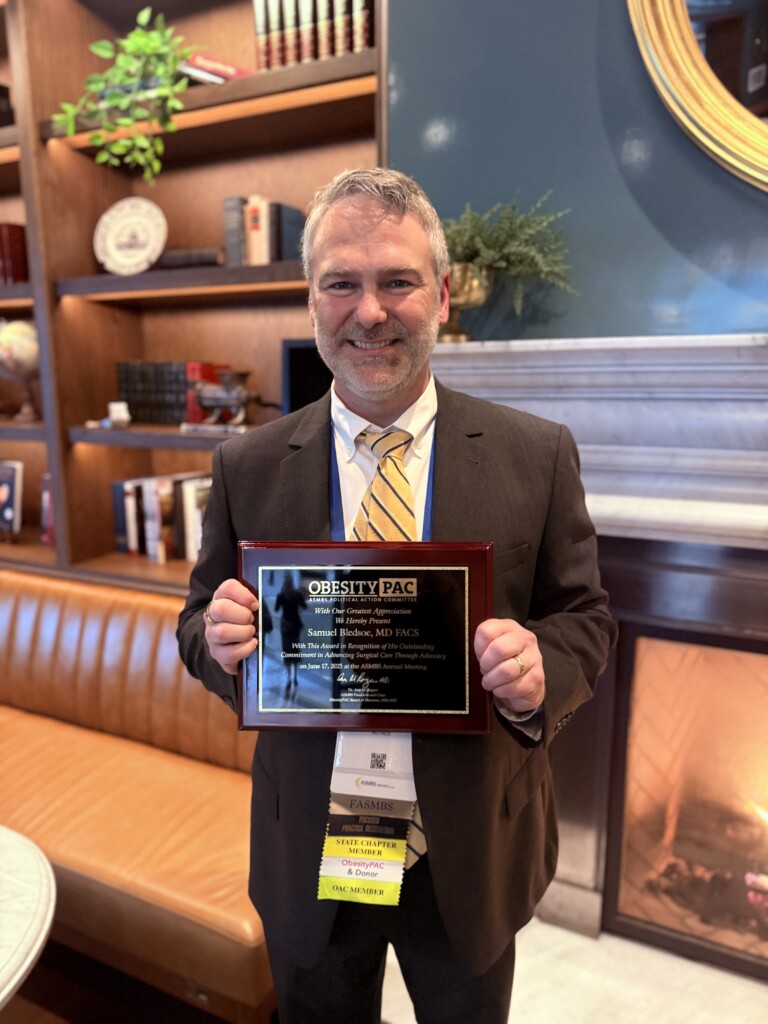
On June 17, 2025, Dr. Bledsoe received the 2025 ObesityPAC Advocacy Award at the American Society for Metabolic and Bariatric Surgery (ASMBS) Annual Meeting in Washington, D.C. Presented by the ASMBS Political Action Committee, the award recognized his outstanding commitment to advancing surgical care through advocacy, particularly the work associated with Arkansas Act 628.
The award recognized the role that physician participation in the legislative process can play in expanding access to evidence-based medical care.
Leadership in the Arkansas Medical Society
Dr. Bledsoe’s advocacy extends beyond bariatric surgery through his work with the Arkansas Medical Society (AMS). Founded in 1875, the Society represents the interests of Arkansas physicians and provides a statewide forum for professional leadership, advocacy, and issues affecting patients and healthcare delivery.
Dr. Bledsoe previously served as an AMS district trustee and as Secretary. He was elected President-Elect in April 2026 and is scheduled to assume the presidency during the Society’s annual meeting, April 16–17, 2027, at Oaklawn in Hot Springs, Arkansas. The specific installation ceremony time has not been independently confirmed.
This leadership role builds on his earlier work in state healthcare policy while broadening his focus to the concerns of physicians across specialties, practice settings, and communities.
His involvement in organized medicine reflects an interest in ensuring that physicians have a practical voice in decisions affecting patients, clinical practice, and healthcare delivery.
Current Initiative: Hospital Discharge Planning and Patient Transitions
Dr. Bledsoe has been working with physician colleagues and other stakeholders on the challenges faced by patients who no longer require acute hospital care but cannot be safely discharged because appropriate post-acute placement, guardianship arrangements, or necessary community resources are unavailable.
These situations can result in prolonged hospital stays, reduce capacity for patients who need acute care, and create additional challenges for patients and families. The work examines barriers involving post-acute placement, decision-making and guardianship, payer processes, and the availability of community-based alternatives.
Dr. Bledsoe has participated in a multidisciplinary effort to examine practical policy and operational options, including improved discharge coordination and access to appropriate post-acute settings. These remain proposals and ongoing discussions, not enacted reforms or implemented programs.
Current Initiative: Artificial Intelligence in Medicine
Another area of Dr. Bledsoe’s involvement is the responsible use of artificial intelligence in healthcare. As AI tools become more common, physicians and healthcare organizations must address questions involving clinical oversight, patient privacy, professional accountability, and the continuing importance of physician judgment.
His developing work in this area addresses how physicians and healthcare organizations can evaluate and adopt AI tools responsibly. Key considerations include clinical accuracy, appropriate human oversight, patient privacy, transparency about limitations, and accountability for decisions affecting patient care.
The goal is to encourage useful innovation without allowing technology to displace the clinical judgment, trust, and responsibilities at the heart of the physician-patient relationship. These discussions are ongoing; formal policy results should be added only when they are available.
Looking Ahead
As he prepares to serve as President of the Arkansas Medical Society in 2027, Dr. Bledsoe’s interests encompass physician participation in healthcare policy, improved patient transitions, responsible medical innovation, and access to high-quality care across Arkansas.
From public-employee coverage discussions to legislation affecting commercial insurers and broader initiatives through organized medicine, his advocacy has been rooted in challenges encountered in everyday clinical practice—and the belief that physicians should contribute their experience when healthcare policy is made.
READY TO EXPLORE WEIGHT LOSS SURGERY?
Start by checking your insurance benefits through UAMS Health in Bryant. Our team will help you understand your coverage and next steps.
Prefer to speak with someone? Call (501) 252-6650